
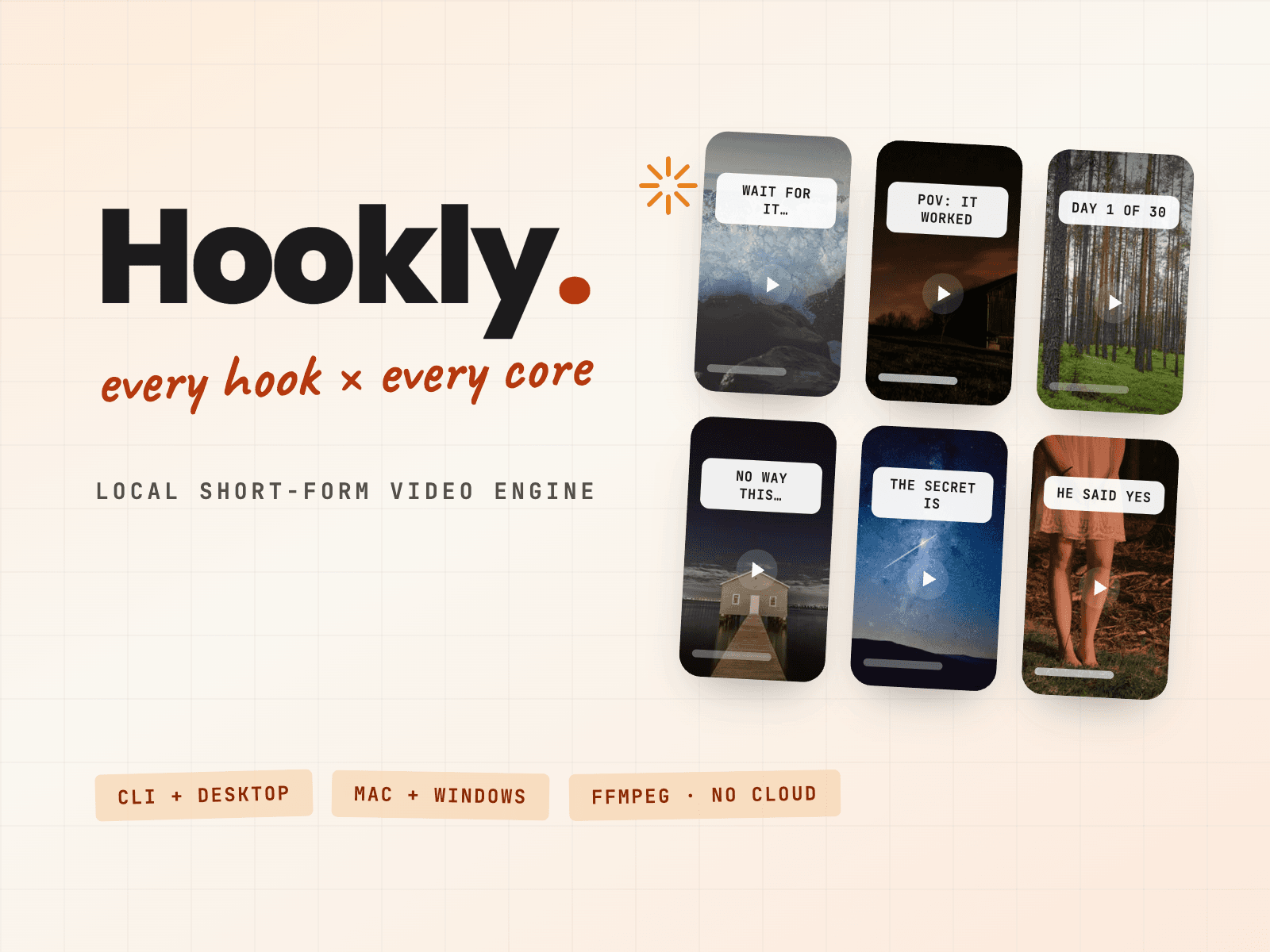
What is it

Techie Labs runs a short-form content operation built on hook testing: many opening "hook" clips paired against "core" body clips, rendered out as every combination and measured. The production step was a bottleneck; the process and the caption judgment lived with whoever edited last.
Hookly de-silos that workflow, and it shipped twice:
- hookly-cli is a Claude Code plugin. Drop in a folder of hooks and a core clip, and Claude watches the footage, writes Snapchat-style hook captions that set up the core's payoff, and renders every hook × core pairing with the caption burned in. The process travels with the repo, so anyone on the team can produce hooks.
- Hookly is the desktop version, an Electron app for macOS and Windows for the visual half of the job: frame each clip inside the 9:16 output by dragging and zooming, trim on a CapCut-style filmstrip timeline, style captions in a live WYSIWYG preview, box out AI watermarks, then render the full N × M matrix locally with a progress bar.
Everything is deterministic and local: bundled ffmpeg and Chromium do the work on the user's machine. No accounts, no uploads, no cloud.
The interesting parts
- Preview is pixel-identical to the render. Framing math and caption HTML live in one shared module, used by both the live preview and the render pipeline, so what the editor sees is exactly what ffmpeg produces.
- Captions are HTML. Caption presets render in Chromium to a transparent PNG, then get composited by ffmpeg, which keeps typography, outlines, and highlights exactly as designed instead of approximating them in filters.
- Watermark removal that blends. Drop a box over an AI-generated sparkle (Veo, Gemini) and the region is reconstructed and feathered into the footage rather than covered with a hard rectangle.
- A matrix, not a queue. The output grid previews every hook × core combo playable in place before anything renders; the render then produces one MP4 per pairing.
Release
v0.1.0 shipped in July 2026 with installers for macOS (Apple Silicon) and Windows. Both repositories are public on GitHub under a proprietary license: Techie Labs holds an internal-use grant, and the IP stays with me. The CLI installs straight into Claude Code as a plugin from the repo.