Context
Systemic Digital is a U.S. web design and funnel agency serving contractors and home-service businesses — companies getting their websites rebuilt (or built from scratch) with conversion funnels behind them. The agency practices what it sells: a done-for-you marketing system for contractors.
 Open live
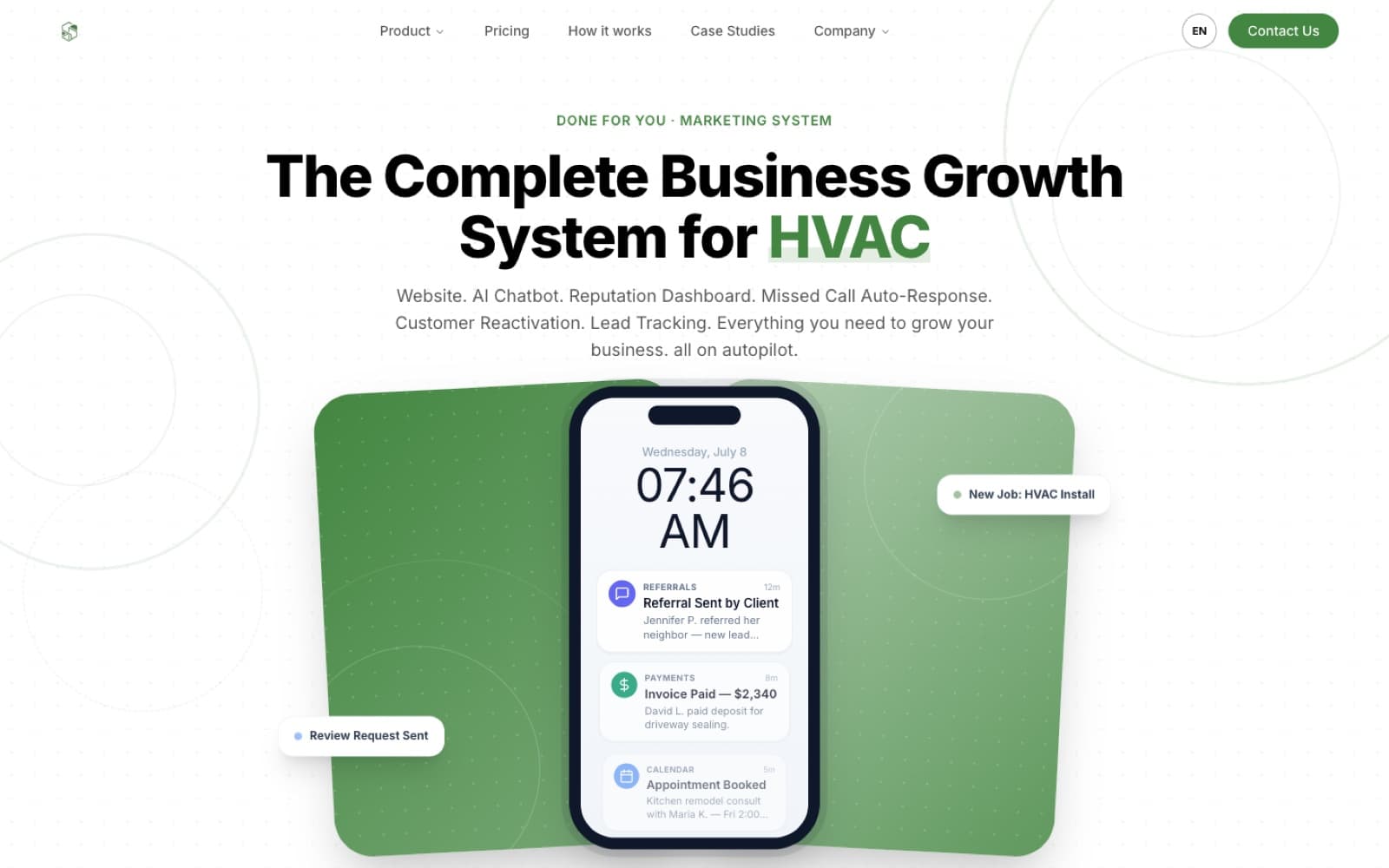
Systemic Digital's product — the done-for-you marketing system they sell to contractors. My contract was behind the scenes: the delivery operation that serves the clients it brings in.
I joined in February 2026 as a Workflow Optimization & Automation Specialist on a project contract with one mandate: reduce the manual workload carrying the agency's delivery, and raise the productivity of its web-dev and funnel-specialist team.
The Challenge
The agency's delivery worked — clients got their sites and funnels — but it ran on manual effort in three compounding ways:
- Repetitive work sat with the specialists. The web-dev and funnel team spent recurring hours on tasks that looked identical from client to client, which capped how many clients the same team could serve.
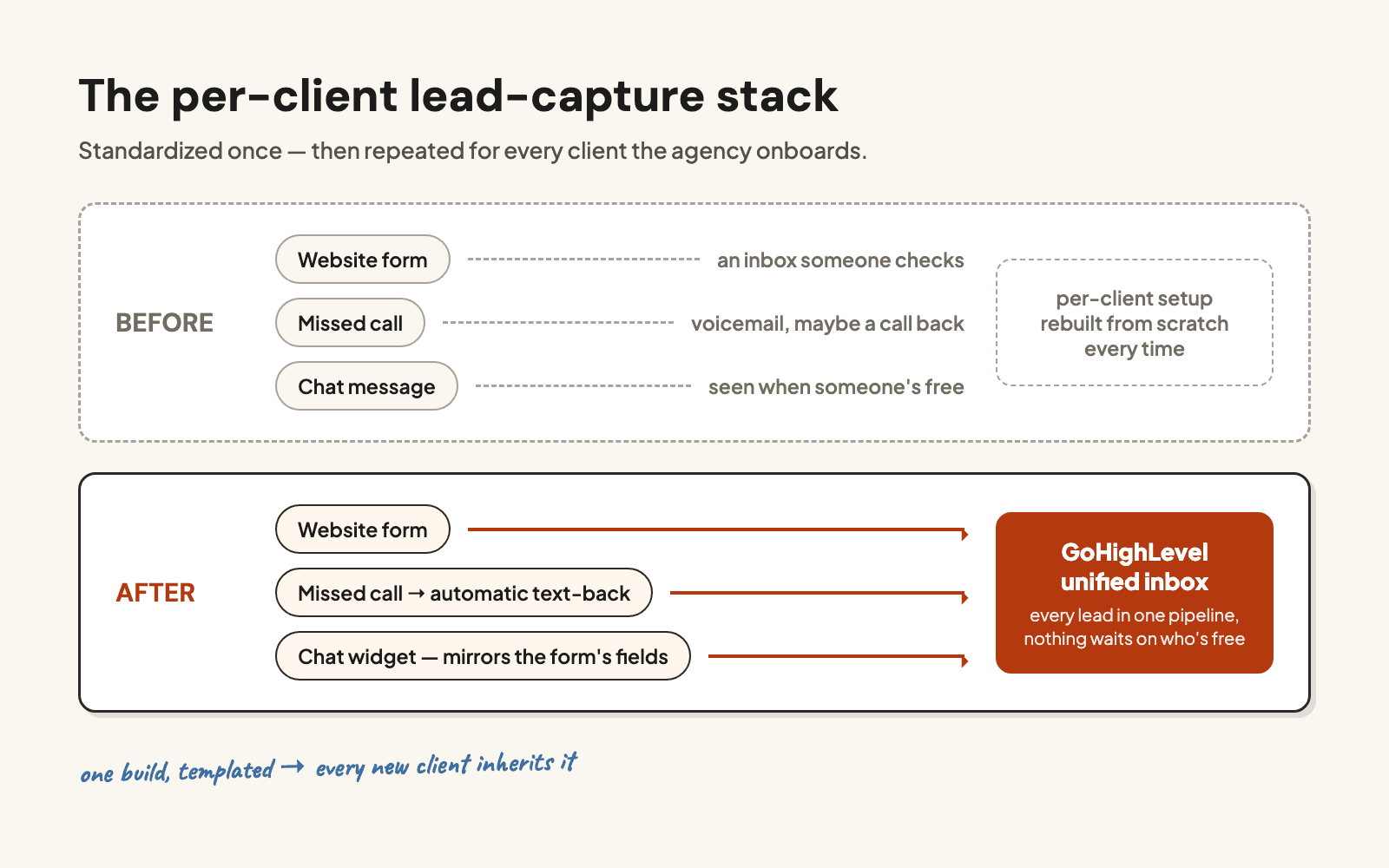
- Per-client setups were rebuilt from scratch. Every new client meant re-assembling the same lead-capture plumbing by hand — forms, follow-up, chat — with per-client variations that made nothing reusable.
- A flagship service ran ad-hoc. Google Business Profile optimization — including the agency's review-filtering technique for lifting clients' local rankings — lived in practitioners' heads rather than in a system anyone could run consistently.
The Framework
This contract is where my signature loop crystallized. I didn't arrive with it — it came out of needing a reliable way to find which parts of an unfamiliar operation actually deserve automation.
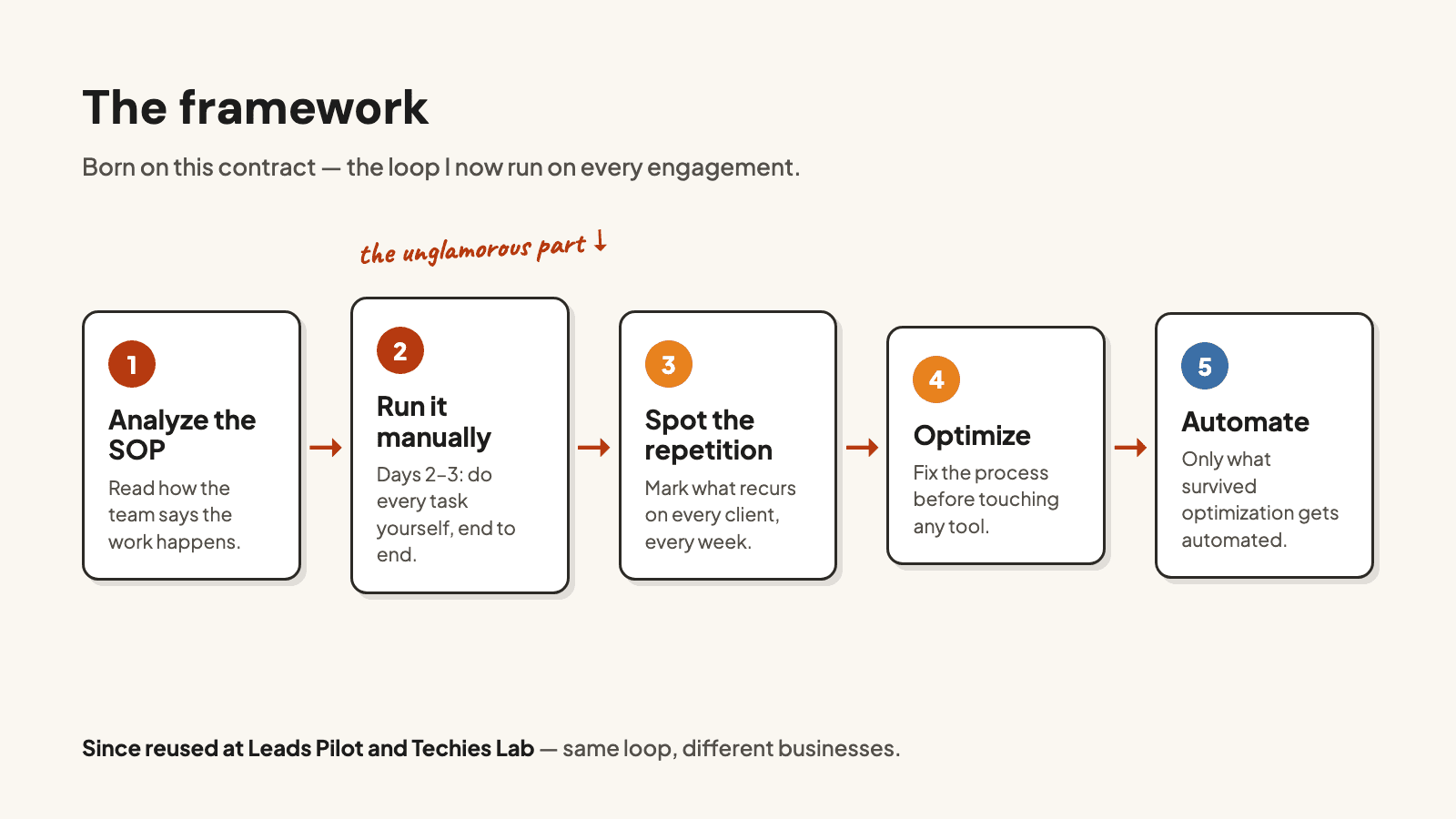
The middle step is the one most people skip. Reading an SOP tells you how the work is supposed to happen; running every task yourself for two or three days tells you how it actually happens — where the real time goes, which steps exist only by habit, and what breaks when you hurry. Only after that does automation have a target worth hitting. Automating a process you haven't run is how you get fast versions of broken workflows.
What Shipped
- Streamlined client delivery. The recurring, identical-across-clients work came out of the specialists' hands — the team's time moved toward the work that actually needed their judgment.
- GBP optimization systematized. The agency's Google Business Profile service — including the review-filtering ranking technique — went from ad-hoc practice to a documented, repeatable process.
- The per-client lead-capture stack, standardized. One reference build, templated so every new client inherits it: website forms feeding a GoHighLevel unified inbox, missed-call text-back/call-back automation, and a chat widget mirroring the form's capture fields.
Timeline
- February 2026. Contract start. SOP analysis, then the manual run — every recurring delivery task, done by hand.
- February – April 2026. Optimization and automation passes; GBP service systematization; the standardized GHL stack built and templated.
- April 2026. Delivered and handed over. Contract completed on delivery — the systems were the deliverable, and they didn't need me to keep running.
Reflection
The most valuable thing to come out of this contract wasn't any single automation — it was the method. The analyze-the-SOP, run-it-manually, then-automate loop has since carried me through every engagement after it: the same sequence at Leads Pilot, the same sequence at Techies Lab. Systemic Digital is where I learned that the boring part — doing the job by hand for a few days — is what makes the automation part actually work.
What I'd repeat
Earning the automation. Every process I automated here, I had first run manually to the point of being annoyed by it. That annoyance is data: it points at exactly the steps worth removing, and it keeps you honest about which "inefficiencies" are actually load-bearing judgment calls. I'd run the same loop again on any operation I hadn't seen before — and I have, on every contract since.