
Context
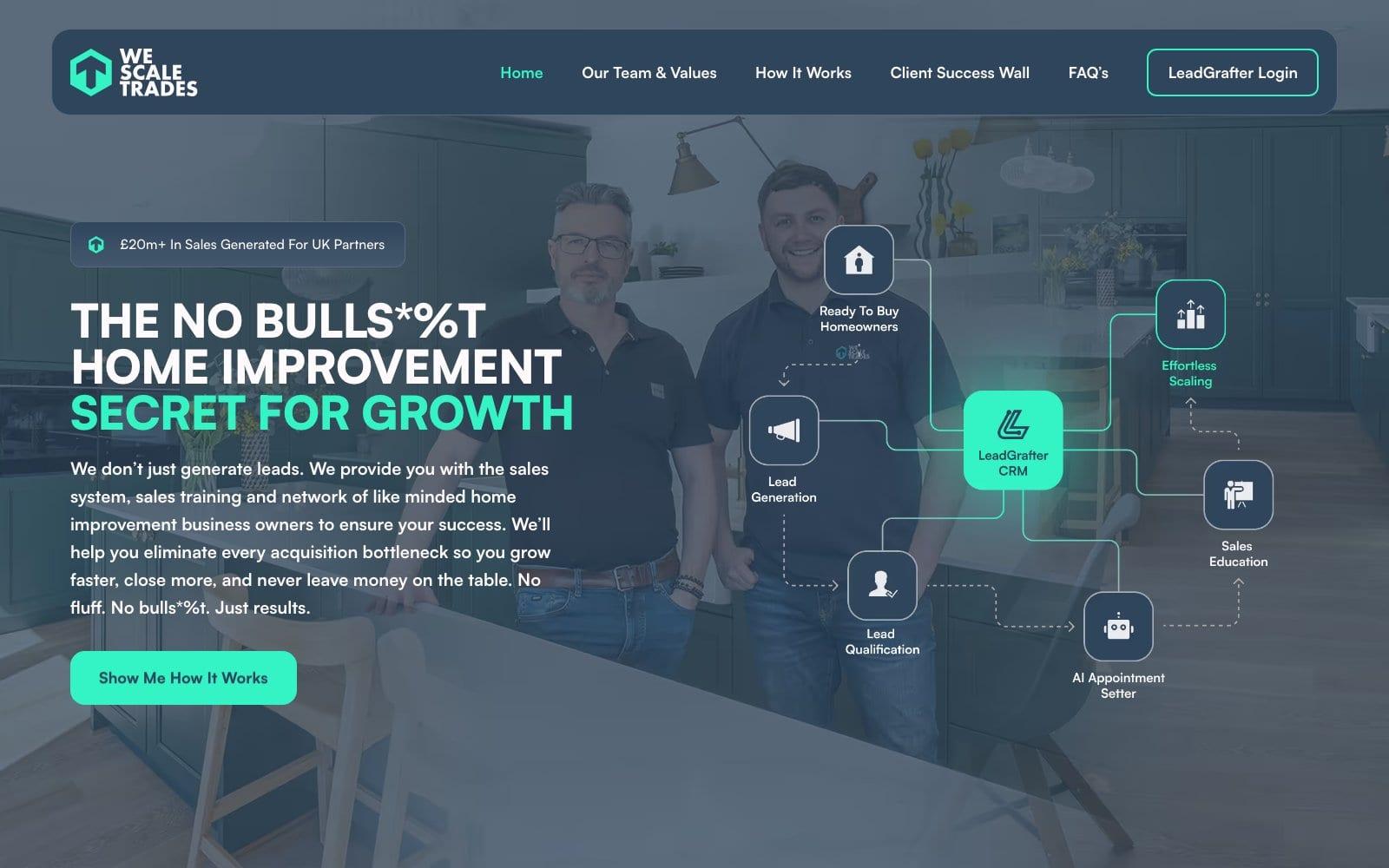
We Scale Trades is a U.K. lead-generation agency for trade and home-improvement businesses: windows and doors, solar, kitchens, bathrooms, lofts, boilers, garden rooms and more. It runs the ads, and every client's leads flow through that client's own GoHighLevel account. An AI appointment setter texts new leads, a setter calls them, reminders go out before the appointment, and the client follows it all on a dashboard.
 Open live
At its peak that meant about 85 GoHighLevel sub-accounts, serving about 30 trade businesses across about nine trades. New clients are built from a shared master setup, so every account runs the same set of workflows. My side was the systems: the workflows inside those accounts, what connects them to dashboards and websites, and the scripts that check all of them.
The Challenge
- Night leads got no first text. The workflow that texts a new lead split leads into in-hours and out-of-hours. The out-of-hours rule asked for an hour that was both before 8 and after 21, which never happens, so leads arriving between 9 pm and 9 am got no first text. At one client, 9 of 9 night leads went without one.
- Dashboards missing leads and setters. A trigger listened for a tag copied from one client's setup, which other clients' leads never carry, so their leads never reached the dashboard. Where leads did arrive, the setter was often blank, because the dashboard webhook fired before the lead was assigned.
- Leads with no automation. At a solar and electrical installer, most leads came from Google Ads, and no workflow fired on them: no setter assigned, no call, no follow-up. The setter rang them by hand.
- One fault, many accounts. A fault in the shared setup repeats in every account built from it. Fixing accounts one at a time is slow, and it leaves the next new client with the same fault.
What I Built
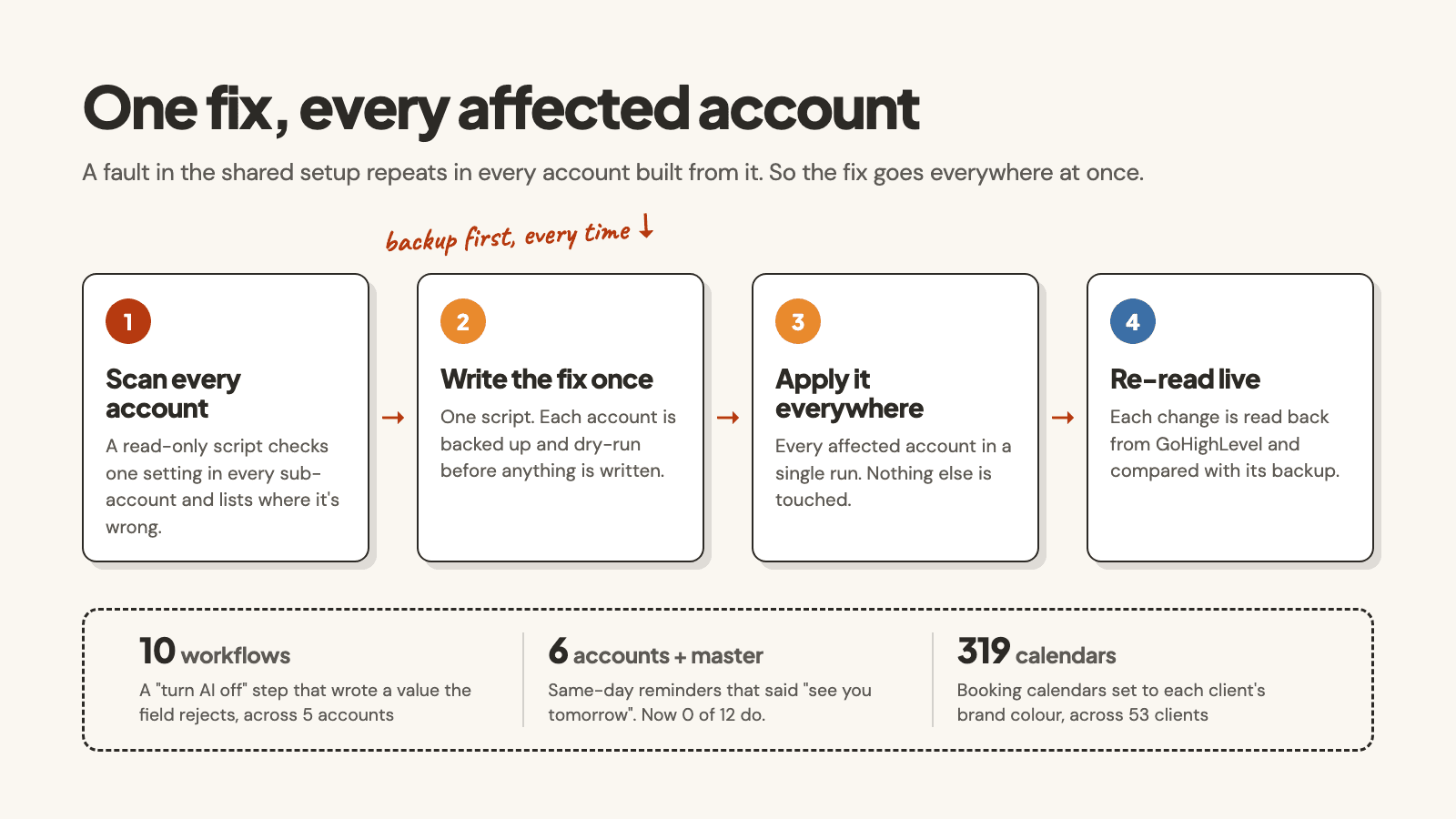
Fleet-wide fixes. For a fault that came from the shared setup, I wrote one script that scans every account read-only, backs up what it will change, does a dry run, writes the fix to every affected account in one run, and then reads each change back from GoHighLevel. Ten workflows across five accounts were writing a "turn AI off" value the field doesn't accept; all ten now write the valid one. Six accounts and the master setup stopped emailing "see you tomorrow" on the day of the appointment. And 319 booking calendars across 53 clients got their client's brand colour in one sweep.
Night leads. I rewrote the hours rule so every hour of the day lands in exactly one branch, using the shape of a fix already working in another account, and applied it to the accounts I was working on, both new clients included. Real overnight leads then got their first text.
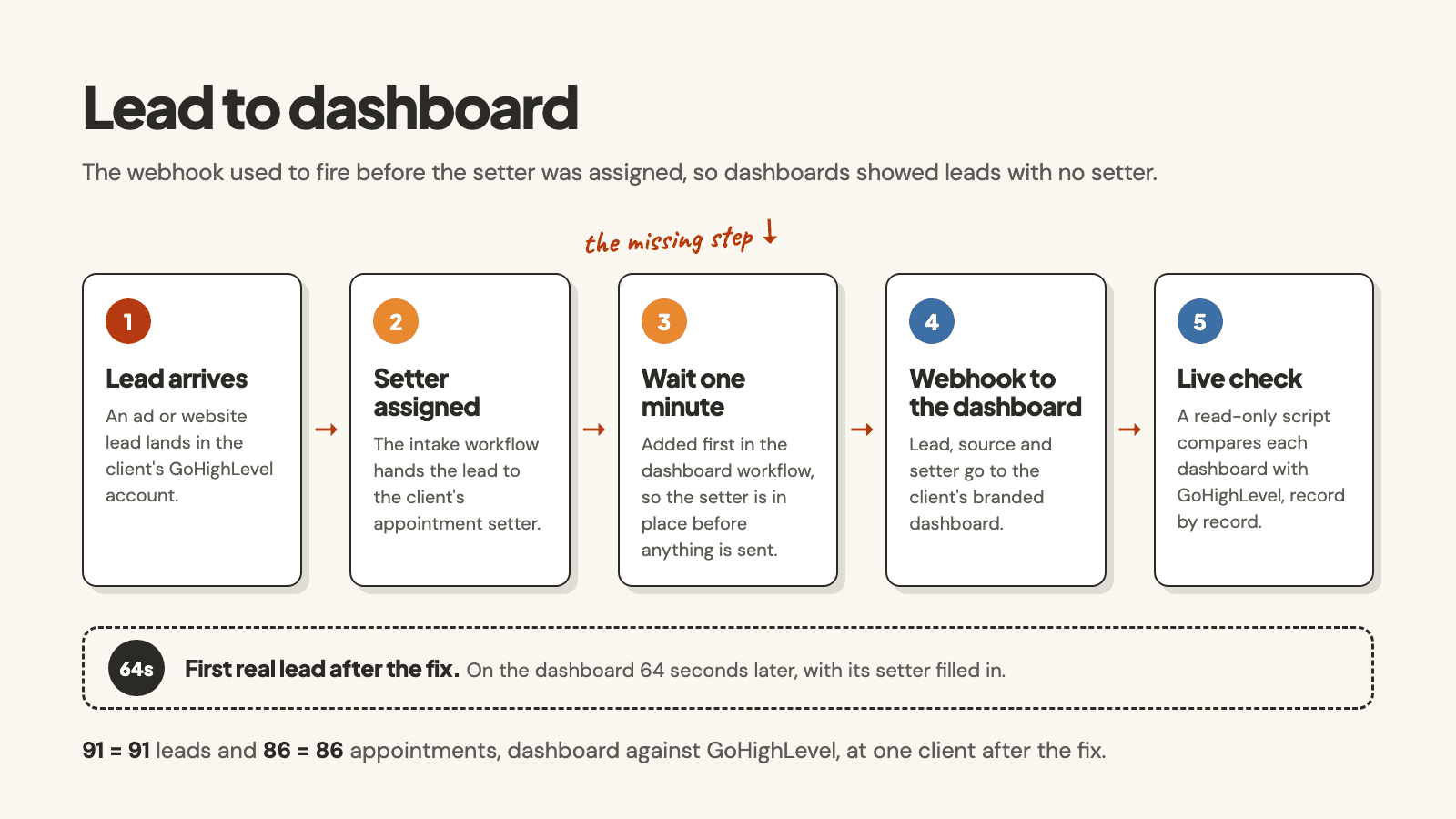
Dashboard wiring. Each client follows their leads on a branded dashboard fed by webhooks from GoHighLevel. I connected client dashboards to their GoHighLevel accounts and fixed what kept them from matching: the trigger listening for the wrong tag, webhooks sending a secret header the dashboard rejected without any error showing in the workflow, and the webhook that fired before the setter was assigned. That last one needed a one-minute wait at the start of the dashboard workflow, so the setter is in place before anything is sent. Then I backfilled what had been missed, and wrote a read-only check that compares each dashboard with GoHighLevel record by record.
Google Ads intake. At the solar and electrical installer, I built intake workflows for the Google Ads leads: tag the lead, assign the setter, send it to the dashboard, ring the setter's phone within minutes during working hours, then queue a run of follow-up calls through the day.
Past-customer reactivation. For the same client, I imported 387 old customers through the API after the bulk import in GoHighLevel stalled, then enrolled 401 past customers in two call queues, one for boiler customers and one for rewiring customers, each assigned to the setter. Neither the import nor the enrolment sent a single text or email.
AI appointment setter. The AI setter is an Appointwise agent that texts each lead and books the appointment. I changed agents through the Appointwise API: openers that name the right business, qualifying questions, tone. At one client the AI could only offer days four to seven out, because the calendar it books from required four days' notice and the AI looks one week ahead. I moved the notice to 48 hours.
Integrations, proven with real traffic. A client's website forms posting into GoHighLevel by webhook, because their web developer's spam protection only worked with their own form plugin. An inbound phone-call lead source, so a caller becomes a lead with a source, a setter, a call sequence and a dashboard row. A client's dashboard writing back into GoHighLevel, so marking an appointment or a sale on the dashboard moves the card in their pipeline. None of them counted as done until a lead had passed through end to end.
Two new clients, end to end. Two windows companies set up from the master setup: users, calendars, custom values, the AI setter workflows, dashboards, page titles, quote templates and contact cards.
A migration that lost nothing. One client moved from an older setup to the new master setup. All 1,497 opportunities were kept and 35 of 35 workflows copied, then every reference the copy left pointing at the template was remapped to the client's own pipelines, emails and values. I wrote it up as a step-by-step guide for the next migration.
An ad copy generator. A small Base44 app for the media buyers. Drop in an ad video and the words are transcribed in the browser with Whisper, so the video never uploads. Claude writes three versions of copy for each ad plus three headlines for the campaign, and each version is checked for AI-sounding writing and rewritten once if it fails.
Audit scripts. Read-only scripts that check every account: booking windows and free slots, custom values, branding, dashboard webhooks, and whether each dashboard matches GoHighLevel. Several of the fixes above started as one of their findings.
The stack: Python against the GoHighLevel and Appointwise APIs, webhooks into Base44 apps, and Claude. Every write was backed up first and read back after. I build with Claude Code as my pair: I design each system, direct the sessions, review and ship.
Results
- 51 leads restored to three client dashboards after the trigger fix. A re-check the next day found none missing.
- Dashboards match GoHighLevel exactly. At one client the setter was filled on only 10% of dashboard leads. After the one-minute wait and a backfill of 83 rows, the dashboard matched GoHighLevel: 91 = 91 leads and 86 = 86 appointments. The first real lead after the fix reached the dashboard 64 seconds later, with its setter.
- 6 of 10 silent webhook failures fixed at one client. They sent the wrong secret header and were rejected; a live form test passed after the fix.
- 28 rejected leads replayed on their own days after a client name mismatch between GoHighLevel and the dashboard. That dashboard now matches GoHighLevel day by day.
- 19 of 19 Google Ads leads called by the setter, 10 within ten minutes, at a client where those leads used to have no automation. The instant ring reached the setter about 2.4 minutes after a lead arrived.
- 0 → 760 free slots on a booking calendar that told leads it was fully booked. Its booking window was one day wide, so on several days a week it fell entirely on the weekend.
- 387 past customers imported and 401 enrolled in call queues, with 0 accidental texts or emails.
- 4 missed commission sales recovered. Six workflows sent the wrong secret header to the agency's commission tracker; after the fix the missed sales were backfilled.
- AI booking notice from days 4–7 out to 48 hours at one client, where the AI setter's bookings had a median of 6.6 days out.
- One run per fleet fix: 10 workflows across 5 accounts; 6 accounts and the master setup, where now 0 of 12 same-day reminder steps say "tomorrow"; 319 calendars across 53 clients.
What I'd repeat
Fix the template, not the account. When every client is built from one master setup, a fault is rarely one client's fault. Scanning the whole fleet first shows where it lives, and fixing the master as well as the live accounts is what stops the next new client from starting with it.
A fix isn't done until a new lead proves it. A published workflow and a clean diff only show the change was saved. The dashboard wait counted once a real lead arrived with its setter 64 seconds later, and the night-lead fix counted once overnight leads got their first text. Until then it is a fix that should work.