
WritingMay 19, 2026
AI agents pass demos. They fail 96% of real SaaS work.
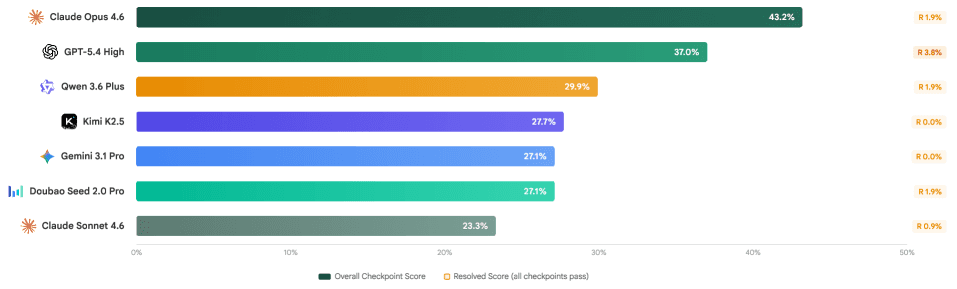
SaaS-Bench just tested frontier AI agents across 106 real professional workflows. End-to-end completion rate: under 4%.
Every demo you've seen was accurate — in demo conditions. That's the gap this post is about.
The benchmark nobody's quoting
SaaS-Bench [1] evaluated the strongest available frontier agents against 106 real-world professional tasks across actual SaaS tools. Planning, multi-step data transformations, report generation, compliance lookups, CRM updates. The kind of thing you'd actually deploy an agent to do.
Completion rate end-to-end: fewer than 4%.
Not a mid-tier model. Not last year's API. The best agents available to any operator today. Sub-4% on real tasks.
The immediate response from the agent vendor community is always the same: "benchmarks don't capture what agents are really good at." That's what every vendor says when a benchmark catches them short. It's not a defense.
The more honest read: demo environments are built to succeed. Real SaaS environments are built to do actual work — 14 tools, three legacy integrations, a Zapier workflow from 2022 nobody knows how to shut off, a Salesforce instance where half the fields were labeled by an intern. The benchmark isn't catching agents at their worst. It's catching them on the kind of work you'd actually assign them.
The failures weren't random noise either. Planning collapsed first. State tracking across tools broke down systematically. Error recovery — the thing agents are supposed to be good at — didn't work when the environment returned unexpected outputs, which is what real environments do constantly.
Error compounds across steps
SaaS-Bench's headline number is striking. The Microsoft Research finding beneath it explains the mechanism.
Microsoft ran a 20-iteration delegation stress test on frontier models handling multi-step document and spreadsheet workflows [2]. Without safeguards, artifact fidelity degraded 19–34% per iteration on unstructured tasks. Python pipelines were the exception: under 1% degradation.
Translation: every time an agent passes its output forward, it introduces drift. One step at 90% fidelity is fine. Five steps at 90% each: 59% of the original fidelity reaches the end. Ten steps: 35%.
 Source: Microsoft Research — Further notes on our research on AI delegation and long-horizon reliability
Here's what that compounding looks like without a human gate:
flowchart TD
  Input(["Task input — fidelity baseline"]) --> A["Agent step 1\nRead + extract data"]
  A --> B["Agent step 2\nTransform + call tool"]
  B --> C["Agent step 3\nUpdate external system"]
  C --> D{"Human checkpoint?"}
  D -->|No checkpoint| E["Agent step 4\nValidate + branch logic"]
  E --> F["Agent step 5\nWrite final output"]
  F --> G(["Output — Microsoft found 19–34% fidelity\nloss per unverified iteration"])
  D -->|Checkpoint added| H["Human reviews, corrects drift"]
  H --> I(["Continue — compounding error contained"])
  style G fill:#ff6b6b,stroke:#cc0000,color:#fff
  style I fill:#51cf66,stroke:#2f9e44,color:#fff
Python is the outlier because the environment is structured, error signals are explicit, and failure is loud. That's the shape of an agent-friendly task. The further a task gets from that — unstructured inputs, cross-app state, fuzzy success criteria — the faster fidelity erodes.
| Task category | SaaS-Bench completion | Primary failure mode | What this means for your stack |
|---|---|---|---|
| Structured data queries | ~15–20% | State tracking across tools | Add explicit state checkpoints between apps |
| Document workflows | ~5–10% | Artifact fidelity drift | Human review after each major transformation step |
| Long-horizon coordination | under 2% | Context accumulation errors | Break into monitored sub-tasks; don't chain |
| Multi-app data updates | ~3% | Cross-system state inconsistency | Validate data pre- and post-write, not just on error |
| Python scripting tasks | ~40–60% | Syntax / API errors (recoverable) | Exception handling + retry logic; most recoverable |
Certified doesn't mean accurate
Ontario's Auditor General tested 20 government-certified AI medical scribes last week [3]. These tools had passed formal approval processes, received certifications, and were deployed in real clinical environments.
Results: 45% fabricated clinical information. 60% inserted incorrect drug data. 85% missed patient mental health details.
The certification process weighted accuracy at 4% of the approval score. Domestic presence got 30%.
I'm not using a healthcare edge case to make AI look bad across the board. I'm pointing at what "certified" means when vendors set the eval conditions and regulators score on domestic presence instead of accuracy.
If you're deploying AI in any regulated professional context — legal, financial, compliance, medical — you're operating in a structurally similar gap. The tool may have passed the approval process. That process may not be measuring what breaks in production.
The Ontario audit is also a preview of what happens when the agent backlash shifts from benchmark papers to government reports. That shift is already underway.
I covered a related pattern in Claude knows it's being tested — your evals are optimistic. The dynamic is consistent: eval environments, demo conditions, and certification tests all share the same structural flaw — they're controlled, and production isn't.
Why enterprises are still going all-in
PwC announced this week it's deploying Claude Code and Cowork to 300,000+ professionals globally [4]. Insurance underwriting: 10 weeks cut to 10 days. Incident response: hours cut to minutes. Advocate Health: 167,000-person rollout.
Those numbers don't square with a 4% benchmark. How?
PwC isn't deploying autonomous agents. They're deploying supervised agents — tools that draft, flag, route, and recommend, with human checkpoints at the state transitions that matter. The 70% delivery improvement isn't AI completing everything autonomously. It's AI handling the rote work (data gathering, first-draft summarization, pattern matching across documents) while humans sit at the judgment calls.
Vendors sell autonomous. Benchmarks say 4%. The gap isn't a release cycle away — it's what you get when you skip the human-in-the-loop gates that make large deployments actually work.
The operators landing real results aren't handing over the process. They're redesigning it: AI handles the parts where compounding error doesn't matter, humans sit at the checkpoints where it does.
That's also the model I scope for fractional digital operations work — supervised loops, not autonomous pipelines. The structure I use on client engagements isn't "let the agent run," it's "identify where the agent is right 95% of the time and guard the 5% that matters." See how that plays out in practice on a real SMB stack.
What I'm watching
The "autonomous agent" framing is cracking. Not because the technology isn't advancing — it is. But the marketing got ahead of the capability by two years, and the benchmarks are catching up publicly now.
What's coming: a shift from "autonomous" to "supervised," from "agentic" to "human-in-the-loop orchestration." That's already where enterprise deployments land. The SMB vendor messaging will follow in the next 12–18 months, probably after a few high-profile failures get cited in the same breath as Ontario's audit.
Three questions to run before deploying any agent workflow:
How many steps does the real task take? If more than five, break it into supervised sub-tasks. Don't chain.
What's the cost of wrong output at step N becoming ground truth at step N+1? If the answer is "minor, we'll catch it in review," fine. If it's "a client gets bad advice," that step needs a human gate.
Have you tested in your actual environment? Not the vendor sandbox. Your SaaS stack, your data shape, your edge cases. Demo conditions are not production conditions. That's the whole problem.
The short version
- SaaS-Bench tested frontier agents across 106 real professional workflows — fewer than 4% completed end-to-end
- Microsoft Research found 19–34% artifact fidelity degradation per iteration in multi-step agent chains without human checkpoints
- Ontario certified 20 AI medical scribes — 45% fabricated clinical information; the certification process weighted accuracy at just 4% of the score
- PwC's 300,000-professional Claude deployment works because it's supervised, not autonomous — AI drafts, humans decide at the judgment calls
- The operator test: count your steps, map the error cost per step, test in your actual environment before you build your ops around it
Sources
[1] SaaS-Bench — "Evaluating Frontier AI Agents on Real-World Professional SaaS Workflows" — arxiv.org
[2] Microsoft Research — "Further notes on our research on AI delegation and long-horizon reliability" — microsoft.com
[3] Office of the Auditor General of Ontario — AI Medical Scribe Audit, May 2026 (reported by The Register) — theregister.com
[4] Anthropic — "PwC Expanded Partnership" — anthropic.com
Drafted with Claude, reviewed and edited by Bryan before publish.