
WritingJune 5, 2026
Anthropic filed its S-1. Here's what else moved this week.
Anthropic just filed a confidential S-1 with the SEC. Uber burned a full year of AI tool budget in four months. Alphabet committed $80B to compute infrastructure — the largest single capital raise in tech history. This week wasn't primarily about model releases. It was structural signals: vendor accountability, cost walls, and the infrastructure bets that change pricing assumptions across the board.
This week at a glance
| Signal | Operator action | Timeline |
|---|---|---|
| Anthropic S-1 filing | Build multi-vendor model routing fallback | Before Q3 |
| Microsoft MAI-Code-1-Flash | Re-benchmark AI coding pipelines | This month |
| Amazon Q VPC private MCP | Wire internal tools through VPC | This month |
| Uber AI spend cap | Model per-tool costs before any rollout | Before next rollout |
| Stripe Adaptive Pricing | Enable cross-border local currency display | This week |
| Ramp AI agent corporate card | Dedicate AI agent spend to its own cost center | This month |
| Alphabet $80B raise | Re-baseline Google Cloud AI capacity assumptions | Q3 planning |
Models + launches
Anthropic files a confidential S-1 — Anthropic filed a confidential draft S-1 with the SEC on June 1 to pursue an IPO [1]. The filing is confidential, so there's no prospectus to read yet — but the structural shift it signals is legible. Private Anthropic runs on founder discretion. Public Anthropic runs on quarterly earnings pressure, investor-driven pricing scrutiny, and institutional growth targets. Every operator building on the Claude API is now on a vendor transitioning into a different accountability structure. The window to model a multi-vendor routing fallback — before lock-up mechanics and IPO pricing define the new normal — is closing.
flowchart TD
    A["Anthropic files confidential S-1\n(June 1, 2026)"] --> B["IPO transition begins"]
    B --> C["Quarterly earnings\npressure on pricing"]
    B --> D["Institutional investor\nscrutiny of API margins"]
    B --> E["Lock-up window:\nfounder discretion narrows"]
    C & D & E --> F["Operator risk:\nsingle-vendor Claude dependency"]
    F --> G["Action: add a second model provider\nto your routing layer now"]
MAI-Code-1-Flash: 51.2% on SWE-Bench Pro, 60% fewer tokens than Haiku 4.5 — Microsoft shipped MAI-Code-1-Flash this week and the benchmark is hard to argue with [2]: 51.2% on SWE-Bench Pro against Claude Haiku 4.5's 35.2%, using 60% fewer tokens. What separates it from the usual benchmark leaderboard entry: it was trained on GitHub Copilot harnesses — real pull requests, code review patterns — rather than optimized against benchmarks directly. Available in VS Code and Copilot today. Any operator pricing AI coding pipelines on Haiku-tier accuracy and cost now has a direct Microsoft competitor that beats both numbers.
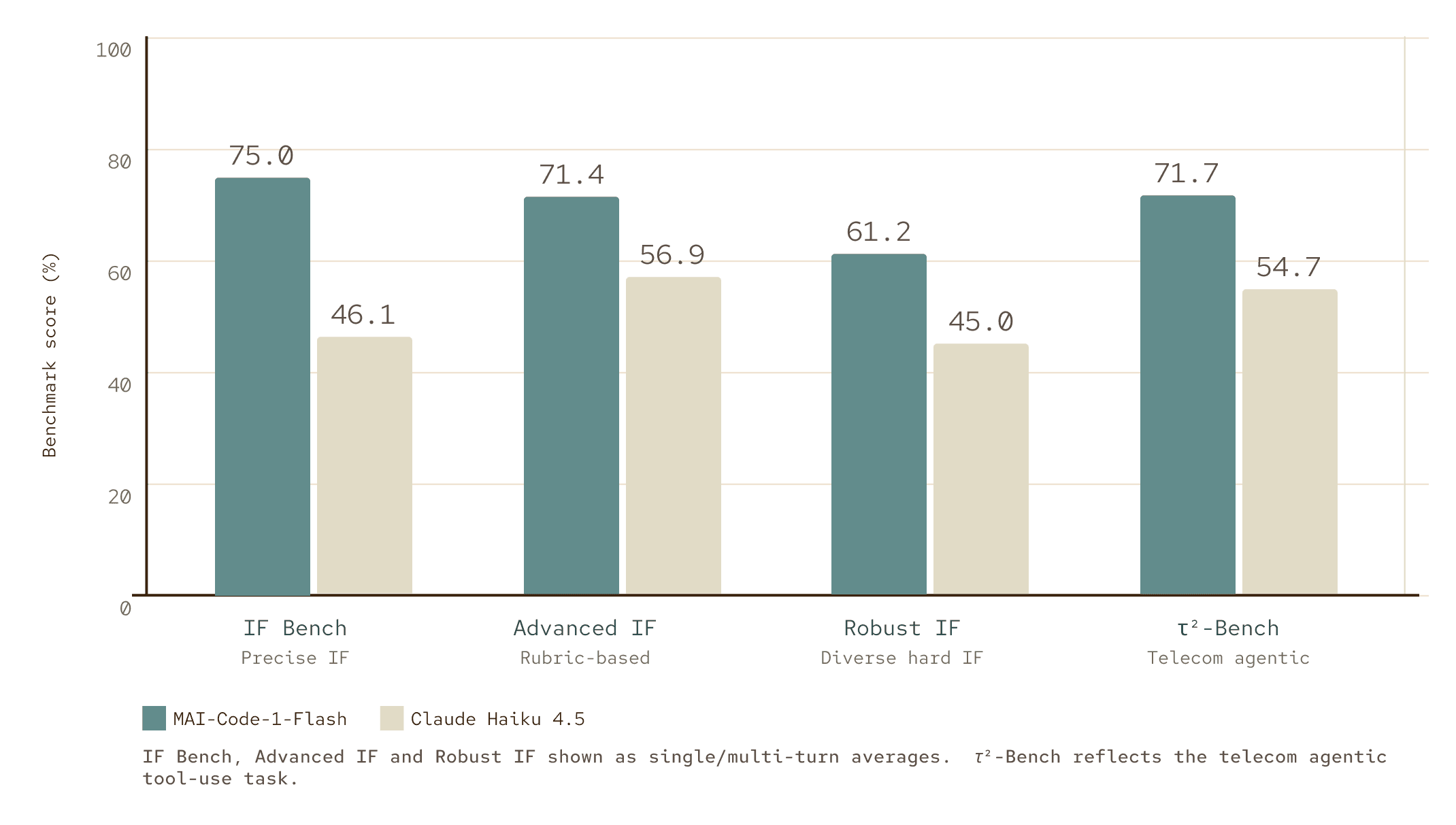 Source: Microsoft — Introducing MAI-Code-1-Flash
Tooling shifts
Amazon Q routes private MCP connections through your VPC — AWS shipped private MCP server support for Amazon Q: internal databases, ERP systems, and proprietary tools can now connect through your existing VPC without firewall rule changes or internet exposure [3]. This removes the last structural objection most enterprise security teams had to wiring internal knowledge into an AI interface. "We can't expose it without an internet-facing integration" was a real blocker for a lot of teams. If you've been building workarounds around this gap, audit whether they're now redundant.
SMB angles
Uber capped AI tool spend after burning a year's budget in 4 months — Uber encouraged engineers to use Claude Code and Cursor as much as possible, tracked usage with internal leaderboards, burned through its entire annual AI tool budget in four months, then capped every engineer at $1,500/month per agentic coding tool [4]. The cap is not the lesson. The missing cost model is. Before your next agentic tool rollout: model baseline, 3x, and 10x usage scenarios. Set a spend alert at 150% of baseline. Add the cap at your 10x ceiling. Do this before the leaderboard, not after.
Stripe Adaptive Pricing: 17.8% cross-border lift from a config change — Stripe's Sessions 2026 announcements on June 4 included Adaptive Pricing — AI-driven local currency display — with documented results: 17.8% cross-border revenue lift, 4.7% subscription conversion uplift, 5% auth rate boost [5]. Also shipping: Checkout Studio with 125+ payment methods and local market recommendations. If you're running Stripe for cross-border sales and haven't enabled Adaptive Pricing, you're behind the conversion baseline your competitors can reach with today's Stripe defaults. This is a configuration change, not an integration project.
Ramp's AI agent corporate card and token-spend management layer — Ramp hit $1.5B ARR with positive FCF, tripled its valuation to $44B in a year, and launched a corporate card built specifically for AI agents to make autonomous purchases plus a token-spend management layer [6]. The product framing is the signal: autonomous AI spend is now a formal financial control category, not a line item buried inside software subscriptions. If your agents incur cost through a shared human card, you have zero cost attribution and no spend controls on what's becoming one of your fastest-growing operational line items.
Adjacent to watch
Alphabet commits $80B to AI infrastructure — Alphabet announced the largest single capital commitment in tech history: $80B for AI infrastructure expansion, directly behind Google Cloud compute [7]. The operator implication isn't "Gemini gets better." It's that the supply-side constraint on Google Cloud AI is being resolved at scale. Any benchmarks you've run on Gemini capacity, latency, or pricing reflect pre-raise infrastructure. The competitive pricing pressure from a vendor that just resolved its supply constraints with $80B in equity will ripple across all cloud AI providers. Re-baseline your vendor assumptions before Q3 planning.
You don't have an AI vendor problem. You have a single-vendor dependency on a vendor that just filed for an IPO. Model the multi-vendor fallback before the lock-up window closes.
What I'm watching: how Anthropic structures API pricing post-IPO. Whether the alignment-focused mission shapes a genuinely different pricing model — or whether public-market growth expectations flatten it into the same usage-based maximization every other API vendor runs.
Sources
[1] Anthropic — Confidential draft S-1 SEC filing — anthropic.com
[2] Microsoft — Introducing MAI-Code-1-Flash — microsoft.ai
[3] AWS — Amazon Q Quick VPC MCP — aws.amazon.com
[4] TechCrunch — Uber caps employee AI spending after blowing through budget in four months — techcrunch.com
[5] Stripe — New ways to turn global demand into revenue — stripe.com
[6] TechCrunch — Ramp raises $750M at $44B valuation — techcrunch.com
[7] Alphabet — Proposed $80B equity capital raise to expand AI infrastructure — abc.xyz
The short version
- Anthropic filed a confidential S-1. If your stack has no model routing fallback, now is the time to build one.
- Microsoft's MAI-Code-1-Flash beats Claude Haiku 4.5 on SWE-Bench Pro at 60% fewer tokens. Re-benchmark before your next AI coding spend commitment.
- Uber burned a year's AI tool budget in 4 months by skipping the cost model. Do the 3x/10x scenario before the leaderboard, not after.
- Stripe Adaptive Pricing shipped with a 17.8% documented cross-border revenue lift. Enable it before your competitors do.
- AI agent spend needs its own cost center. Ramp just made that a product category.
- Alphabet's $80B raise resolves the Google Cloud AI supply constraint. Re-baseline your vendor pricing assumptions before Q3.
Drafted with Claude, reviewed and edited by Bryan before publish.