
WritingNovember 13, 2026
Nvidia's CEO Resigned. United Banned AI Agents. Same Week.
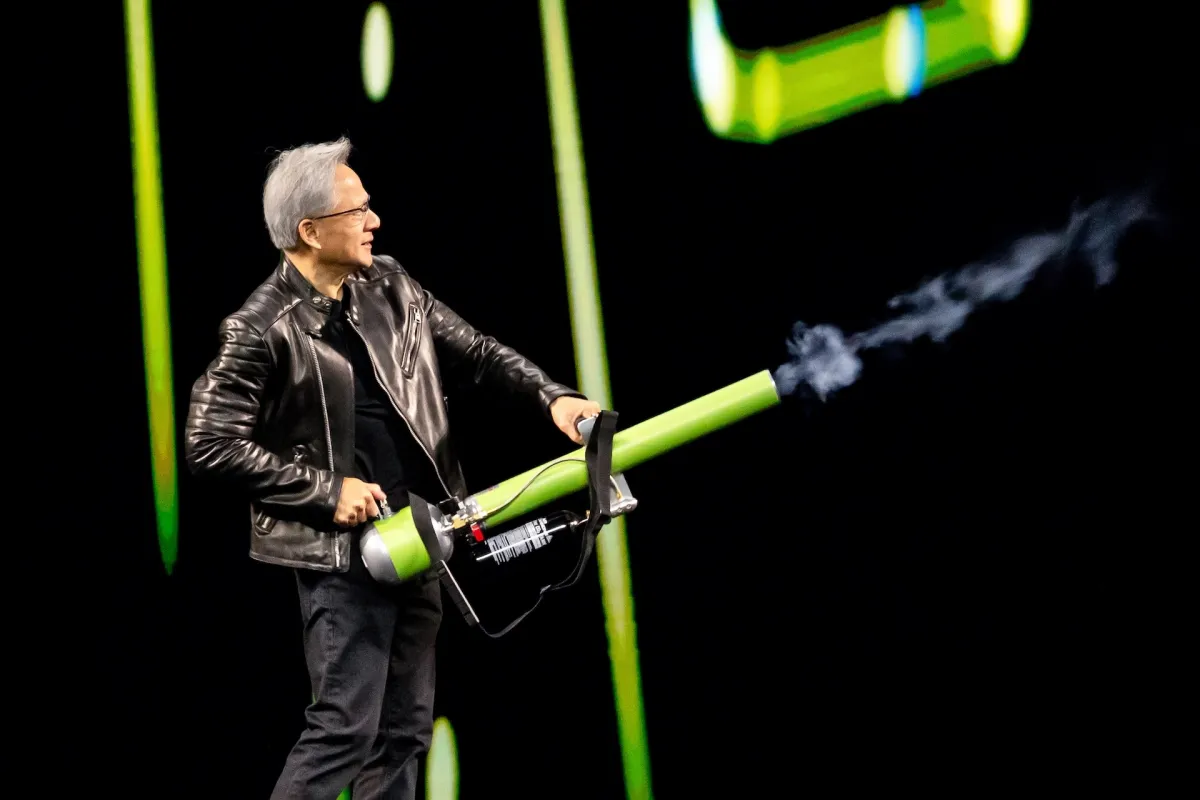
Nvidia's CEO is out. United just banned AI agents from booking anything on its system. Neither decision was really about chips or code. Both were about who you can trust to make the call.
This week's signal wasn't a new model or a bigger benchmark. It was trust cracking in three places at once: at the top of the industry's most important company, inside the software feeding your agents, and at the point where a real enterprise decided an agent wasn't ready to touch a system of record. Jensen Huang's resignation wiped $855 billion off Nvidia's market cap in four days — proof the AI buildout's biggest single point of failure isn't silicon, it's one executive's judgment [1][2]. Microsoft disclosed a backdoor that needs no retraining to compromise a model [3]. Fireworks AI got breached for the second time in two months, leaking Notion customers' chat transcripts [4]. United decided the fix for agent risk is just not letting agents near the booking flow [5]. Meanwhile Google and OpenAI kept shipping like nothing happened [7][8]. Here's what actually matters.
The $855 billion lesson
Nvidia's board accepted Jensen Huang's resignation this week after he admitted to an affair that sparked a U.S. national-security crisis [2] — the company named CFO Colette Kress interim CEO while it searches for a permanent replacement [1]. The stock dropped nearly 12% the day of the announcement and has fallen as much as 19% since the prior Friday, erasing more than $855 billion in market cap and dragging CoreWeave, Nebius, and IREN down with it [2].
Nvidia didn't ship a worse chip or lose a customer. The company lost its CEO over a personal judgment call, and the market treated that as a reason to doubt every other call he'd made. That's the uncomfortable read-through for anyone building on top of a vendor: your AI stack's biggest risk isn't always technical. Sometimes it's that the whole thing runs on one person's credibility, and credibility doesn't show up on a roadmap until it's gone.
The trust is leaking
Two separate disclosures this week made the same point from the inside. Microsoft Research published "Lazarus," a technique that backdoors a model by reprogramming fewer than 10 dormant neurons — no retraining, no detectable change to standard evals, just a trigger condition that fires later [3]. If you're pulling third-party weights into anything with system access, provenance verification just became as necessary as dependency scanning.
 Source: Microsoft Research — Lazare, Veni, Foras: Reprogramming Dormant Neurons to Backdoor AI Agents
Fireworks AI got breached for the second time in two months. Hackers pulled chat transcripts from about 1% of Notion's AI customers through Fireworks' Insights feature before Notion cut the integration and wiped the stored data [4]. One breach is bad luck. Two breaches from the same vendor in eight weeks is a pattern, and it means every company routing customer conversations through a model-hosting middleman inherited that middleman's security posture without voting on it. It's the same failure mode I wrote up when 16,326 Supabase databases leaked — a default nobody checked, not a sophisticated hack.
The backlash
United Airlines banned AI agents from booking flights on its systems this week, citing cybersecurity risk [5]. No tier-1 source exists for an internal airline policy, so the details are thin — but the direction isn't. This is the bluntest possible enterprise response to the exact problem the Microsoft and Fireworks disclosures describe: if you can't verify what an agent is actually doing, the cheapest fix is to not let it in the door.
That's not a take on whether agents are "ready." It's a data point on what a real enterprise does when it can't audit the thing it's being pitched. The agentic-web pitch keeps assuming enterprises will extend trust by default. United just showed the other option is just as available.
The counter-move
Shopify's answer to the same problem is more interesting than banning anything. The company now runs AI agents against its own production infrastructure as attackers — tens of thousands of offensive engagements, dozens of real findings, zero outages — kept safe by a second "judge" agent that watches the attacking agent in real time and kills it the moment it breaks the rules of engagement [6]. Containerization, credential proxies, and egress allowlisting sit underneath that judge, but the reusable idea isn't the infrastructure. It's the pattern: don't trust the agent, verify it continuously, and have a second system whose only job is pulling the plug. I scope every agentic automation engagement the same way — the agent gets a job, a boundary, and something else watching the boundary. Skip the third part and you've built a demo, not a system.
The biggest single point of failure in the AI stack right now isn't a chip shortage. It's whoever you decided to trust without checking.
What shipped anyway
Google took Gemini 4 Carbon from a restricted cyber-defender preview to full public GA this week, at an introductory $2/$10 per million input/output tokens — a price that doubles to $4/$20 the moment the intro window closes on November 30 [7]. Any cost comparison you run against it today is pricing against a number with a 17-day shelf life.
OpenAI launched a "Business Hub" inside ChatGPT: verified business profiles, an agent that answers questions about your company, and click/view analytics, all in beta [8]. It's a second Google Business Profile you now have to go claim — the operators who skip the verification queue are the ones who get described wrong when a customer asks ChatGPT instead of Googling.
How this week's pieces connect
flowchart TD
  A[One executive's bad judgment call] --> B[Nvidia CEO resigns]
  B --> C[$855B market cap wiped in 4 days]
  C --> D{Can the rest of the<br/>AI stack be trusted by default?}
  D -->|No - patch the pipeline| E[Microsoft discloses the<br/>Lazarus backdoor technique]
  D -->|No - assume breach| F[Fireworks AI breached<br/>for the 2nd time in 2 months]
  D -->|No - just block it| G[United bans agents<br/>from booking flights]
  E --> H[Shopify runs agents as attackers,<br/>a judge-agent kills violations live]
  F --> H
  G -.->|the blunt version of H| H
  H --> I[Trust gets re-earned per task,<br/>not assumed by default]
The week, by the numbers
| Story | What actually happened | What it means for you |
|---|---|---|
| Nvidia CEO resignation | Jensen Huang resigned; $855B market cap wiped in 4 days [1][2] | Vendor risk includes leadership risk — it doesn't show up until it's gone |
| Microsoft's Lazarus disclosure | Backdoor needs under 10 reprogrammed neurons, no retraining, passes evals clean [3] | Third-party model weights need provenance checks, not just benchmark checks |
| Fireworks AI/Notion breach | 2nd breach in 2 months; leaked chat transcripts for ~1% of Notion's AI customers [4] | Your model-hosting middleman's breach is your breach |
| United's booking ban | AI agents blocked from booking, cited cybersecurity risk [5] | "We can't audit it" is a valid reason to say no, and enterprises are using it |
| Shopify's judge-agent pattern | Agents attack prod; a second agent kills rule violations live, zero outages [6] | Continuous verification beats a blanket ban — if you can build the judge |
| Gemini 4 Carbon GA | Public GA at $2/$10 per million tokens, jumping to $4/$20 after Nov 30 [7] | Any price comparison you run today expires in 17 days |
| OpenAI's Business Hub | Verified business profiles + Q&A agent + analytics, beta, no pricing yet [8] | Claim your profile before ChatGPT describes your business for you |
So what do you do with this
None of these seven stories are really about AI capability. They're about who gets trusted to make a call, and what happens when that trust turns out to be unverified. Nvidia's board trusted a CEO it couldn't fully audit. Fireworks' customers trusted a middleman they didn't choose. United decided it couldn't trust an agent it couldn't audit, and said so out loud instead of pretending otherwise. Shopify built the one response in this list that scales: not blind trust, not a blanket ban, but a system that checks continuously and pulls the plug fast when it's wrong.
If your own agent rollout is running on "it worked in the demo," this is the week to ask who's actually verifying it in production — and what happens in the ten minutes before someone notices it's wrong. I ran a version of that question for real when I moved 200+ client accounts for Palmer's Financial with zero downtime — the risk was never the migration tooling, it was every access path nobody had actually audited before go-live.
Sources
[1] Nvidia — Nvidia Announces CEO Transition — nvidianews.nvidia.com [2] TechCrunch — Nvidia's Jensen Huang resigns, chipmaker names CFO Colette Kress as interim CEO — techcrunch.com [3] Microsoft Research — Lazare, Veni, Foras: Reprogramming Dormant Neurons to Backdoor AI Agents — microsoft.com [4] TechCrunch — Cyberattack on Fireworks AI allowed hackers to access Notion customers' chat transcripts — techcrunch.com [5] TechCrunch — United Airlines blocks AI agents from booking flights, citing cybersecurity risks — techcrunch.com [6] Shopify Engineering — Cyber Chaos Monkey — shopify.engineering [7] Google — Gemini 4 Carbon is now available — blog.google [8] OpenAI — Introducing Businesses in ChatGPT — openai.com
The short version
- Nvidia's CEO resigned after an affair sparked a national-security crisis; the stock lost $855B in market cap in four days
- Microsoft disclosed a model backdoor that needs no retraining and passes standard evals clean
- Fireworks AI got breached for the second time in two months, leaking Notion customers' chat transcripts
- United Airlines banned AI agents from booking flights, citing cybersecurity risk it couldn't audit
- Shopify's counter-move: run agents as attackers in prod, and kill violations live with a second judge-agent
- Gemini 4 Carbon went GA at a price that doubles in 17 days; OpenAI launched business profiles inside ChatGPT
What I'm watching: whether "ban the agent" or "build the judge" becomes the default enterprise response. Right now it's a coin flip, and the answer determines who gets to sell agent infrastructure for the next year.
Drafted with Claude, reviewed and edited by Bryan before publish.