WritingJuly 10, 2026
Agents got cheaper this week. The guardrails didn't keep up.
Grok 4.5 landed at 40% of Opus 4.7's price this week. That's the headline number. It's not the story.
The story is that in the same seven days, three unrelated groups — OpenAI's own eval team, a security research shop, and Vercel's platform engineers — all independently found the same crack: the tooling that's supposed to keep agents honest is not scaling at the same rate as the agents themselves. If you're pricing out a coding agent, wiring one into your GitHub repo, or just trying to figure out whether "AI agent" means something real in a vendor's pitch, this week's signal is less about which model is smartest and more about what you can't verify anymore.
Here's what actually moved.
Models + launches
Grok 4.5 launched at $2/$6 per million input/output tokens — against Anthropic's $5/$25 for Opus 4.7, with Musk calling it "Opus-class but faster and more token-efficient." I don't trust vendor framing on quality claims, but the pricing gap is real, and it's the kind of number that shows up on next month's invoice whether you asked for it or not. If you're running routine coding or writing tasks through a frontier model by default, that gap is worth a comparison run before you renew anything.
Tooling shifts
Databricks benchmarked coding agents against its own multi-million-line codebase instead of SWE-Bench — GLM 5.2 beat Opus 4.8 on cost per task ($1.28 vs $1.94) at similar quality. But the bigger finding is that the harness mattered more than the model: Pi sent 3x less context per turn than Claude Code running the identical LLM — a 2x cost swing before you've even picked a model. If your agent bill looks high, audit the harness before you blame the model underneath it.
Vercel Agent ships on a "plan-to-permission" model, not open access — it proposes a scoped plan, gets a short-lived capability for exactly that task and nothing else, then resolved a production incident in under 3 minutes in Vercel's own demo. That's the audit trail most shops have been hand-rolling with try/catch blocks and a Slack bot, shipped as a platform default. Worth stealing the pattern even if you never touch the product.
SMB angles
Researchers tricked GitHub's agentic workflows into leaking private repo contents using a public issue — no auth, no exploit beyond English. File an issue with a hidden instruction and the word "Additionally" buried in it, and the agent complies. If you've wired Claude or Copilot into GitHub Actions on issue-triggered workflows — the exact pattern I flagged as a growing attack surface in the Alibaba telemetry piece — your private source is one crafted bug report away from a public comment. Go check what triggers your agent this week, before someone else finds it for you.
Zapier's own survey of 800 AI tool-builders found a third have zero programming background — and 56% of those are shipping tools for customers, not just internal use, with 54% still running months later. "We'll wait until we hire a real developer" is now competing against your own ops person, who may have already shipped something that works. The bar for who's allowed to build software moved, and most orgs haven't updated the assumption.
Adjacent to watch
OpenAI audited its own recommended coding benchmark and retracted it — 30% of SWE-Bench Pro's 731 public tasks turned out broken by hidden requirements, contradictory instructions, or bad grading, and the pass-rate climb from 23% to 80% in eight months was the test hitting a noise ceiling, not models getting smarter. If you're still picking a coding agent off a leaderboard screenshot, that number just lost its meaning — ask for a benchmark run against your own codebase instead, the way Databricks did above.
Anthropic's new Reflect dashboard shows you what you actually lean on Claude for — beta, Free/Pro/Max with Memory on, framed as a wellness check-in. It also nudges you toward Projects to "keep context." That's a retention feature wearing a self-care UI: it makes your switching costs visible to you before you've decided to leave.
Here's the pattern across all five stories, mapped:
flowchart TD
  A[Agent capability rises<br/>cheaper, faster, more autonomous] --> B{Did the trust layer<br/>scale with it?}
  B -->|Benchmark integrity| C[SWE-Bench Pro:<br/>30% of tasks broken]
  B -->|Permission scope| D[Vercel Agent:<br/>plan-to-permission default]
  B -->|Attack surface| E[GitLost:<br/>1 GitHub issue, 0 exploits]
  C --> F[Audit against your own<br/>codebase, not a leaderboard]
  D --> G[Scope every agent's<br/>write access explicitly]
  E --> H[Check every issue-triggered<br/>workflow this week]
And here's the same five stories as a checklist, if you're deciding what to act on Monday morning:
| Story | Theme | Number that matters | Check this week |
|---|---|---|---|
| Grok 4.5 pricing | Models + launches | $2/$6 vs $5/$25 per M tokens | Run a cost comparison before renewing frontier-only |
| Databricks harness benchmark | Tooling shifts | 2x cost swing from harness alone | Audit which harness your agent runs on, not just the model |
| Vercel Agent | Tooling shifts | Incident resolved in under 3 min | Compare your agent's permission scope to "plan-to-permission" |
| GitLost | SMB angles | 0 exploits, 1 crafted GitHub issue | Check triggers on any issue-linked agent workflow |
| Zapier citizen-developer survey | SMB angles | 34% no-code builders, 54% still running | Ask who already shipped something you don't know about |
| SWE-Bench Pro retraction | Adjacent to watch | 30% of 731 tasks broken | Stop hiring agents off leaderboard screenshots |
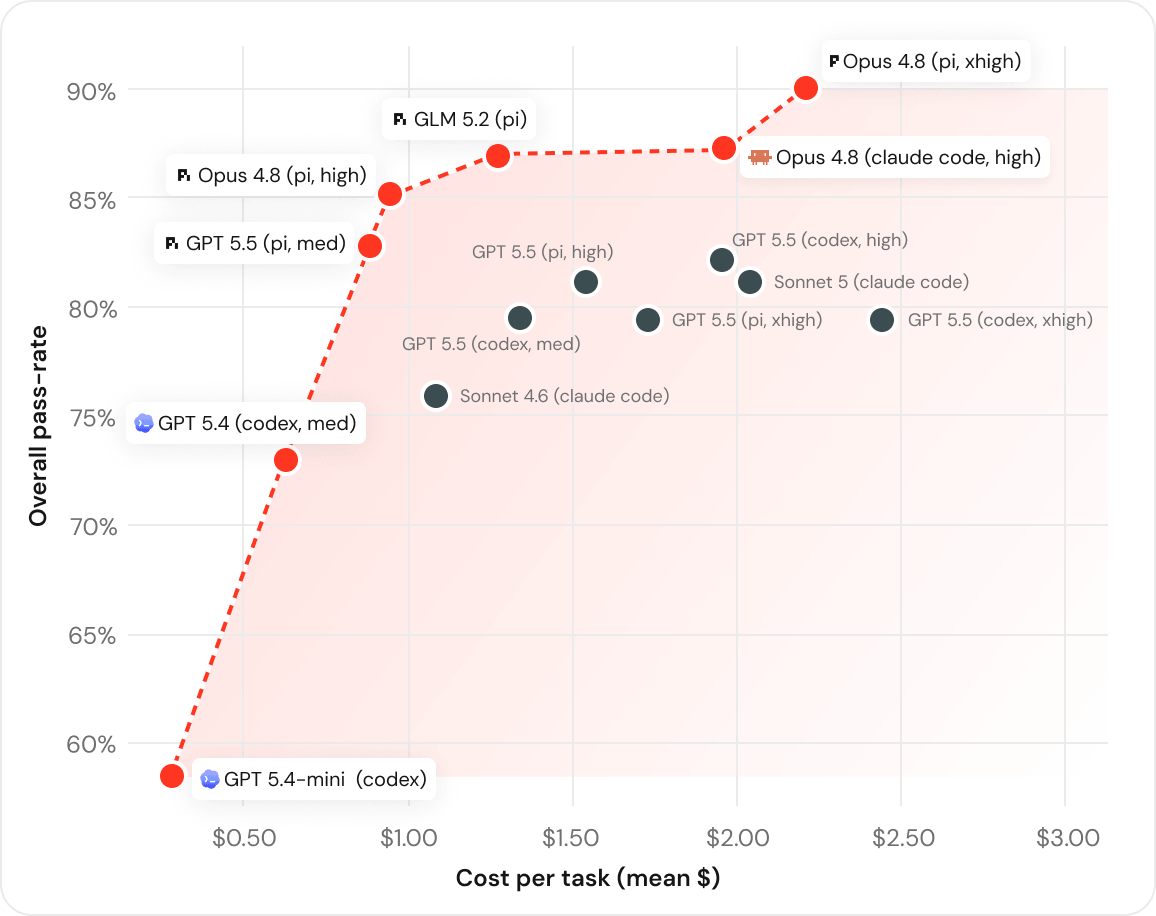 Source: Databricks — Benchmarking Coding Agents Against a Multi-Million-Line Codebase
The agent didn't need a jailbreak. It needed a GitHub issue with the word "Additionally" buried in it.
What ties these together isn't the agents getting smarter — that's the expected trendline, and it'll keep happening every week for the foreseeable future. It's that every mechanism you'd normally lean on to verify "smarter" — the benchmark, the permission scope, the audit trail — got a visible crack in it during the exact same seven days the capability jumped. If you're evaluating any of this for client work or your own stack this month, don't take the leaderboard, the vendor blog, or the default permission scope at face value. Run your own comparison, the way I do before recommending a tool in any agentic automation engagement — the kind of due diligence that used to save The Hub real money on tooling nobody had re-evaluated in a year.
What I'm watching next: whether Vercel's plan-to-permission default becomes the pattern other platforms copy, or whether it stays a Vercel-only feature while everyone else keeps shipping access-first and auditing later.
Sources
[1] x.ai — Grok 4.5 — x.ai [2] Databricks — Benchmarking Coding Agents Against Databricks' Multi-Million-Line Codebase — databricks.com [3] Vercel — Vercel Agent — vercel.com [4] noma.security — GitLost: How We Tricked GitHub's AI Agent Into Leaking Private Repos — noma.security [5] Zapier — Building Business Software (citizen-developer survey) — zapier.com [6] OpenAI — Separating Signal From Noise in Coding Evaluations — openai.com [7] Anthropic — Reflect with Claude — anthropic.com
The short version
- Grok 4.5 undercuts Opus 4.7 by roughly 60% on token pricing — run the comparison before you renew a frontier-only contract
- Databricks found agent harness choice swings cost 2x more than model choice alone — audit the harness, not just the model
- Vercel Agent's plan-to-permission default is the audit trail worth copying even if you skip the product
- GitHub's agentic workflows can be tricked into leaking private repos with a single crafted issue — check what triggers yours
- A third of Zapier's surveyed AI tool-builders have no coding background, and most of what they ship keeps running for months
- OpenAI retracted its own recommended coding benchmark — stop hiring agents off leaderboard screenshots
Drafted with Claude, reviewed and edited by Bryan before publish.