
WritingApril 24, 2026
Cloud Next, GPT-5.5, and the model Anthropic won't release
Cloud Next dropped on Tuesday. Google bet $750M on agent infrastructure, OpenAI shipped GPT-5.5, and Anthropic confirmed they built their most capable model ever — and aren't letting the public near it.
This week the signal was mostly about agents graduating from interesting concept to something you'd actually build on. Google Cloud Next 2026 dominated the week: the A2A protocol hit v1.0 in production at 150 organizations, Workspace Studio launched as a no-code agent builder inside Google Workspace, and Google committed $750M to partners. On the model front, OpenAI shipped GPT-5.5 with a 1M-token context window. And Anthropic confirmed Claude Mythos Preview — the most capable model they've ever built — won't be generally available. Project Glasswing gates access to 50 organizations for one purpose: finding and patching software vulnerabilities. Seven items this week. Six point in the same direction. The seventh is the one I'd sit with.
Models + launches
GPT-5.5 ships with API access and 1M context window
The model handles complex, multi-step work — coding, research, data analysis, cross-tool navigation — with a 1M context window [2]. API pricing: $5/1M input tokens, $30/1M output. That's double GPT-5.4's pricing but matched against higher capability. The practical win for operators running long-document or dense-thread work: no more manual chunking to fit context limits. GPT-5.5 Pro pushes to $30/$180 for higher-accuracy jobs. A maturity step, not a leap.
Anthropic builds its best model ever — and locks it away
Anthropic confirmed Claude Mythos Preview exists and will not be publicly available [1]. Access goes to 50 organizations through Project Glasswing — Amazon, Apple, Microsoft, Google, Cisco among them — specifically to find and fix software vulnerabilities. Using Mythos, Anthropic autonomously identified thousands of zero-day flaws across every major OS and browser, including a 17-year-old remote code execution vulnerability in FreeBSD that gives root access to any machine running NFS. When a lab builds its best model and the first move is to patch the internet rather than ship a product, that tells you something real about where the ceiling actually sits.
Tooling shifts
A2A v1.0 hits production at 150+ organizations
Google's Agent-to-Agent protocol passed its one-year mark this week with v1.0 in production at more than 150 organizations [3], now governed by the Linux Foundation's Agentic AI Foundation. V1.0 added signed agent cards — cryptographic identity verification for agents — enterprise-grade multi-tenancy, and a migration path for early adopters. If you're building multi-vendor agent pipelines, A2A is no longer a spec to monitor. It's the interoperability layer other vendors are already building against.
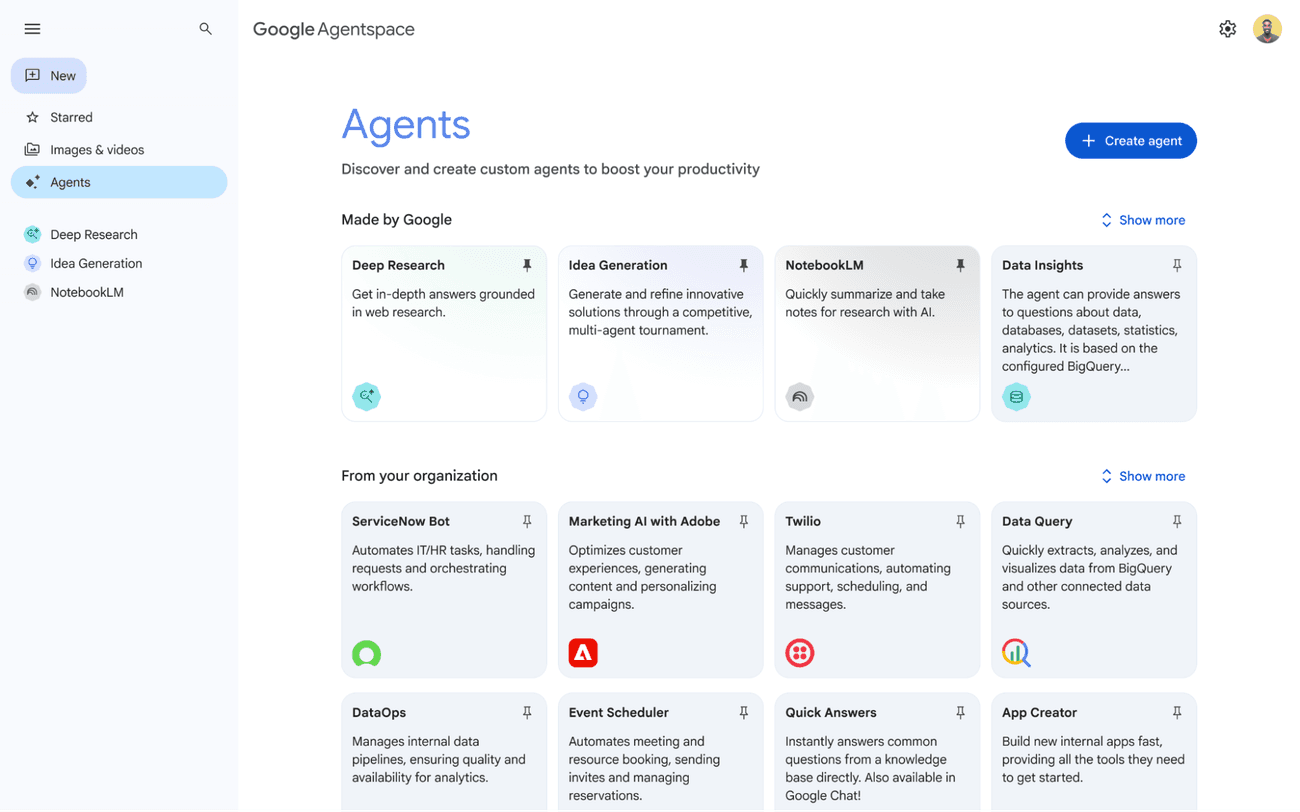 Source: Google Cloud Blog — Agent2Agent protocol is getting an upgrade
Google Workspace Studio + managed MCP servers via Apigee
Google also launched Workspace Studio — a no-code agent builder inside Google Workspace — alongside managed MCP servers via Apigee as an API-to-agent bridge [4]. For SMBs already running on Google's stack, this is what to show clients who ask about autonomous agents without switching platforms. The Apigee/MCP pairing is the more interesting infrastructure move: it turns your existing APIs into callable actions for any agent, not just Google's own.
Zapier Agents gets Pods and Dashboards
Zapier redesigned its Agents product with Pods — organizational containers for related agents — and Dashboards for visibility into what autonomous workflows are actually doing [5]. The first objection every operations team raises before trusting autonomous agents is "how do I see what it did?" Zapier built the answer into the product. For SMBs already on Zapier's 8,000-app network, this removes the main governance blocker to deploying agents. (For the full picture on when Zapier makes sense versus n8n or Make, the automation decision tree still holds.)
SMB angles
43% of enterprises expect to reach agentic AI stage by end of 2026
Zapier surveyed 200 enterprise leaders on AI maturity [6]: 43% expect to reach the agentic stage — linked systems with limited human supervision — by year-end, and 25% are targeting full-scale orchestration, where AI functions as an operating system for the business. Only 30% are still at task-level automation. The gap between where leaders are heading and where most teams actually are is where operators who can build agentic systems make a living in 2026.
Adjacent to watch
SaaS per-seat pricing has a clock on it — McKinsey confirms
McKinsey's analysis [7] is direct: as AI products perform work instead of merely supporting it, per-seat pricing stops making sense — you're paying for units of work, not human users. Gartner's estimate: 70% of businesses will prefer usage-based pricing over per-seat by 2026. For SMBs, this cuts both ways. You stop paying for idle seats. You start budgeting for variability when agents run hard. (That pricing pressure is often what kicks off the kind of stack audit behind The Hub engagement.)
When Anthropic builds its most capable model ever and the first move is to use it to patch the internet — not sell subscriptions — the capability ceiling just told you exactly where it sits.
What I'm watching next week: whether A2A v1.0 gets adoption outside Google-adjacent vendors, and whether Workspace Studio or Zapier Agents' Pods actually land with SMB ops teams — or spend the next six months as enterprise IT demos. If you're evaluating whether to push your operation into the agentic stage this year, that's the kind of decision I help SMBs work through.
Sources
[1] Anthropic — Project Glasswing: Securing critical software for the AI era — anthropic.com
[2] OpenAI — Introducing GPT-5.5 — openai.com
[3] Google Cloud Blog — Agent2Agent protocol is getting an upgrade — cloud.google.com
[4] Google Cloud Blog — Welcome to Google Cloud Next 2026 — cloud.google.com
[5] Zapier Blog — The new Zapier Agents: scalable, organized AI automation — zapier.com
[6] Zapier — State of agentic AI adoption survey 2026 — zapier.com
[7] McKinsey Insights — Upgrading software business models to thrive in the AI era — mckinsey.com
The short version
- GPT-5.5 is in the API — $5/$30 per million tokens, 1M context window. A maturity step, not a leap.
- Anthropic's best model won't ship publicly — Claude Mythos Preview is gated to 50 organizations for vulnerability research only, through Project Glasswing.
- A2A v1.0 is live at 150+ orgs — agent interoperability just graduated from spec to infrastructure.
- Zapier Agents now has governance tooling — Pods and Dashboards give operations teams the visibility they needed before trusting autonomous workflows.
- Per-seat SaaS pricing has a clock on it — McKinsey and Gartner agree. Budget for usage-based, not flat fees.
Drafted with Claude, reviewed and edited by Bryan before publish.