WritingJune 2, 2026
Your ops are fine—until the next growth sprint breaks them
Your operations are probably fine right now. They won't be on the other side of your next growth sprint.
Revenue climbs. The team is busy. Customers are happy enough. Then the sprint hits — new clients, a partnership batch, a campaign that converts harder than expected — and something breaks. Not catastrophically. But the wheels wobble, and you spend two weeks putting them back on instead of building what you should be building.
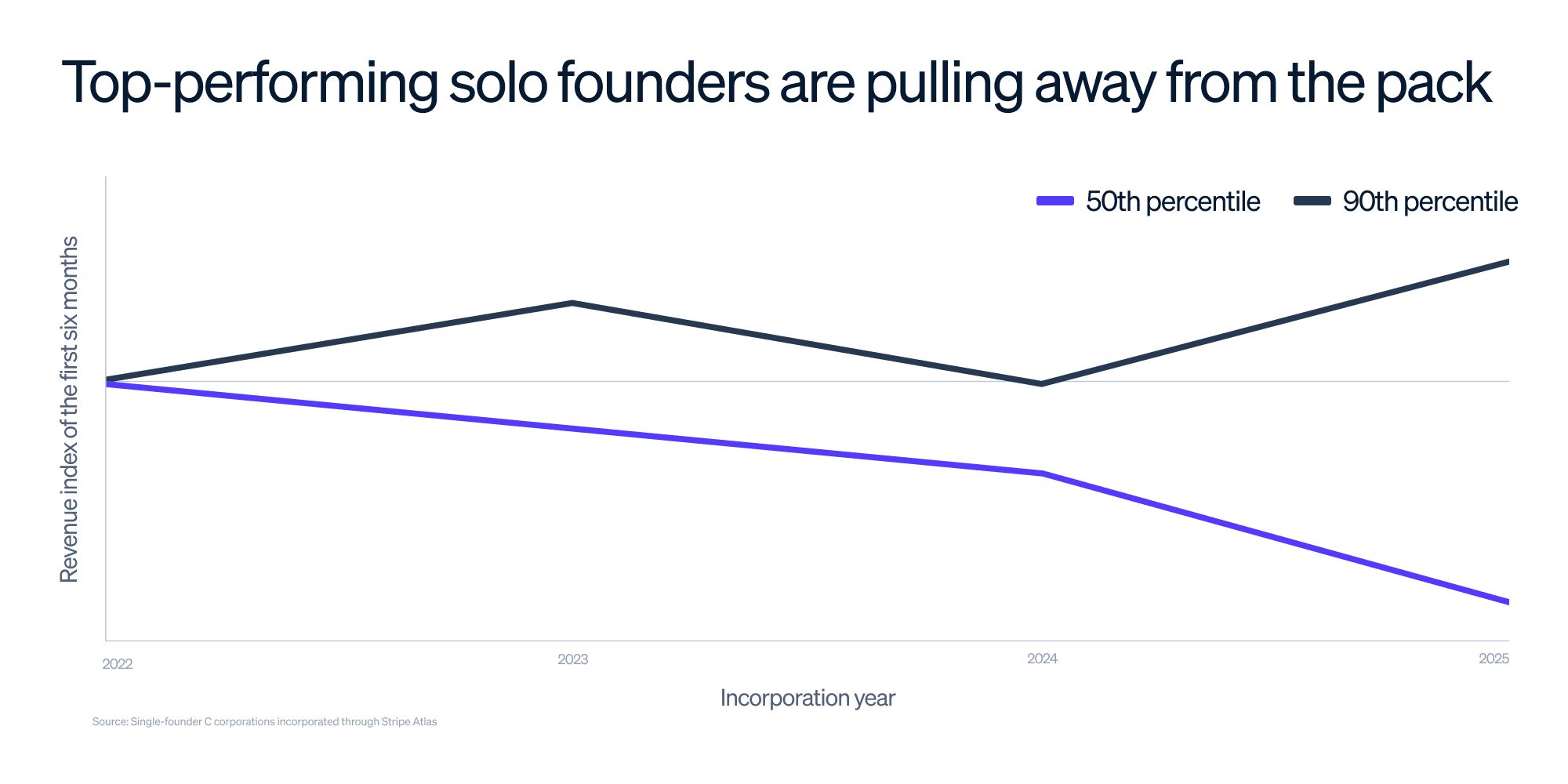
The ceiling doesn't announce itself. That's the problem. Stripe's Q2 2026 Atlas data found that the top decile of solo founders now earns 61 times the revenue of the median. [1] That gap has nearly doubled in four years. Product and market explain part of it. Operations explain the rest. The top decile founders fixed these warning signs before they became walls. The median founders found out the hard way.
Here's the self-check. Run through it against your own business before reading the five sections below.
flowchart TD
  A([Revenue is growing]) --> B{Can the business run<br/>without you for 5 days?}
  B -->|No| C[Sign 3: Owner-dependent ops]
  B -->|Yes| D{New hires useful<br/>in under 4 weeks?}
  D -->|No| E[Sign 2: Process lives<br/>in heads, not docs]
  D -->|Yes| F{Daily manual data<br/>copy between tools?}
  F -->|Yes| G[Sign 4: Human is the<br/>data-routing layer]
  F -->|No| H{Growth spike<br/>triggers a fire drill?}
  H -->|Yes| I[Sign 5: Ops built<br/>for yesterday's volume]
  H -->|No| J{One person routes<br/>all key decisions?}
  J -->|Yes| K[Sign 1: Human is<br/>the system]
  J -->|No| L([Ops can scale<br/>with growth])
  C & E & G & I & K --> M[Ceiling identified —<br/>time to redesign]
Sign 1: One person's inbox is the routing layer for your entire business
You know who I mean.
This person — a co-founder, the ops lead, the EA, the person who "just knows how things work" — is the central processing unit for decisions, handoffs, and exceptions. Email lands in their inbox. Slack messages pile up. Contractors ask them instead of reading documentation, because documentation doesn't exist. Customers escalate to them by default.
The tell: when this person is sick or on a flight without Wi-Fi, the business operates on a four-hour delay on easy things and stops completely on hard ones.
This isn't a people problem. It's a design problem. The business accidentally built a hub-and-spoke operation where one human is the hub. Operations that run on a single person's availability are a sick day away from a bad week.
The fix: every recurring decision needs a documented rule. Every recurring handoff needs a workflow. That person should be the exception handler when the system breaks down — not the system itself.
Sign 2: A new hire takes 3 months to contribute anything useful
Fast onboarding is a proxy metric for documentation maturity.
If someone new needs 90 days to be useful, the gap is almost never the hire. It's that the business's operating knowledge lives in people's heads. The new person has to reverse-engineer how things actually work — by asking questions, making mistakes, and slowly assembling a mental model that everyone else carries implicitly.
That 90-day lag isn't just friction. It's a tax. A $70K/year hire who takes 3 months to contribute costs $17,500 in orientation that should've been a 2-week ramp. Multiply that by every hire you make in a growth year.
The fix is documentation before hiring, not after. If you can't describe the job in a runbook — input, process, output, edge cases — you're not ready to hire for it. You're ready to prototype it with a contractor first.
Sign 3: You can't go dark for 5 days without a 30-item brief
Try this test: block your calendar for next Monday through Friday. Tell the team you'll be unreachable. Watch the reaction.
If the reaction is panic — or if you're immediately listing everything you need to brief someone on before you leave — you've already hit the ceiling.
This isn't a productivity thing. It's a dependency thing. If the business requires your ongoing attention to function normally, you haven't built a business. You've built a job with a team wrapped around it.
The fix isn't delegation alone. It's designing operations so the right people have the right decision authority, documented processes handle the predictable work, and you only get pulled in when something genuinely needs a judgment call. Most things don't.
Ops don't break when things go wrong. They break when things go right — and the volume finally exposes the handoffs held together by one person paying attention.
Sign 4: You're copying data between tools manually. Daily.
This one feels like discipline. It isn't.
The morning copy from Typeform to Airtable to the client tracker to the email tool feels like staying on top of things. Fifteen minutes. Every day. No big deal.
Here's what it actually is: technical debt accruing at compound interest.
That fifteen minutes scales linearly with volume. Double your clients, double the copy-paste time. Triple the team, triple the number of people doing it. Every manual step is a failure point — one missed row, one wrong column, one entry on a bad day, and something breaks downstream without anyone noticing until a client asks.
The automation reality check: Zapier's AutomationBench measured how well AI models perform on real multi-step automation tasks. The best model succeeded about 15% of the time. [2] That's the argument for designing your data flows clearly before you automate them, not waiting for a smarter AI to clean up a process you never mapped. A simple rule-based automation handles a well-documented flow. No frontier model required.
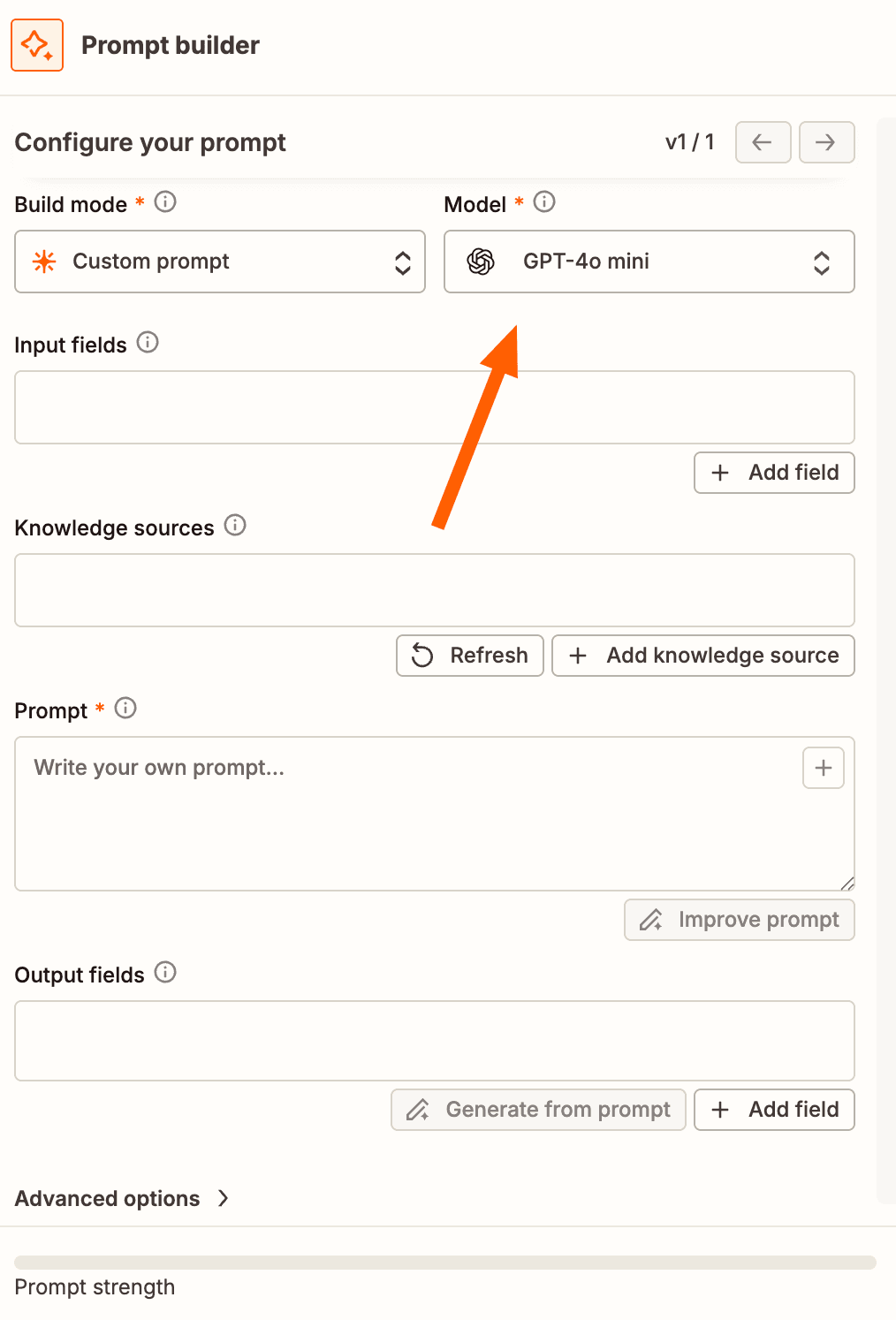 Source: Zapier — AI Models on Zapier
If your business is doing daily manual data copying, you have at least one automation that pays for itself in under a month. The n8n vs Zapier breakdown covers which tool fits which routing job.
Sign 5: Every revenue spike triggers a fire drill
This is the most diagnostic sign of all five.
You land a big new client. A campaign converts harder than expected. A partner sends a batch of referrals. And instead of the business expanding cleanly to handle the volume, you spend the next two weeks in crisis mode — customers waiting longer, internal communication breaking down, you personally closing gaps that should have been handled by a process.
If growth breaks your ops, your ops were built for the business you had. Not the one you wanted.
The pattern I see consistently: businesses that grew manually — founder did everything, then hired people to help do everything — inherit the founder's implicit decision-making as their operating model. That works until volume is high enough that one person can't hold it all in their head. Then it breaks at the worst possible moment.
The fix is pressure-testing before the spike, not during it. Pick a quiet month and simulate double your current volume through your ops for a week. Where does it break? That's your ceiling.
The five signs as a quick reference
| Sign | What it looks like | Risk level |
|---|---|---|
| Single-inbox routing | One person copy-pasted on every key decision | High |
| 90-day onboarding lag | New hires orbit existing staff for months | Medium-High |
| Failed vacation test | Leaving for a week requires a 30-item brief | High |
| Daily data copy-paste | Manual transfers between 3+ tools every morning | Medium |
| Fire-drill growth | Revenue spike breaks internal ops within two weeks | Critical |
Most businesses I work with are sitting in at least two of these simultaneously — usually Sign 1 and Sign 4 together, with Sign 5 waiting on the next growth event to surface.
None of these require a headcount expansion. They require operations design: mapping the actual workflows, identifying the decision points, building the handoffs, automating the data routing. The Hub case study shows what that looks like on a real engagement — a 12-tool stack reduced to 4, manual ops replaced with automated routing, and the team spending time on work that moves the business instead of work that maintains the status quo.
The bad news: every week you delay is another week of operational debt compounding. If any of these five feel familiar right now, a 15-minute diagnostic call is where we figure out which one is the actual ceiling versus which ones are downstream symptoms of it.
Sources
[1] Stripe — Top Solo Founder Traits — stripe.com
[2] Zapier — AI Models on Zapier — zapier.com
The short version
- If one person's inbox routes everything, the business stalls the moment they're unavailable — even for a day
- 90-day onboarding ramps mean the real process lives in people's heads, not in documents; fix the docs before the next hire
- If you can't go dark for a week without a 30-item brief, you've built a job wrapped in a team, not a business
- Daily manual data copying is technical debt that scales linearly with volume and fails with fatigue
- Growth events that trigger fire drills reveal ops built for yesterday's load — pressure-test on a quiet month before the next sprint hits
Drafted with Claude, reviewed and edited by Bryan before publish.